

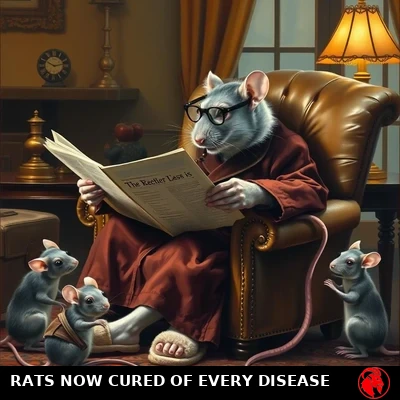
STOCKHOLM — Researchers world-wide have jointly concluded that rats have been cured of every disease and illness known. They went on to reassure the public that this breakthrough carries no risk whatsoever of helping cure humans of any disease.
The team of medical data collators described the finding as 'the single greatest advance in the history of medicine, for rats.' It is the result of hundreds of years of biological rodent research, paid for by organizations and governments that hoped to cure human diseases. The rats are cured. The humans are not.
A follow-up study will determine if the long-lived species can be trained to investigate human illnesses.
“The single greatest advance in the history of medicine, for rats.” — The research team
Across thousands of research protocols, rats are now immune to cancer, heart disease, diabetes, infection, and aging. A faction of rat psychologists have also resolved mental health, again in rats, not humans. Future generations of rats are guaranteed eternal life without emotional suffering, despite being research subjects. The rats abide.
For decades, patients had been told a cure was close. But those patients were rats, in a lab. If humans thought doctors were talking about humans, that is their own fault. "We always explicitly stipulated that our research was being done on rats," noted rodent endocrinologist Dr. Emil Ratcliffe. "We never said we were researching humans. Why would you draw that connection?"
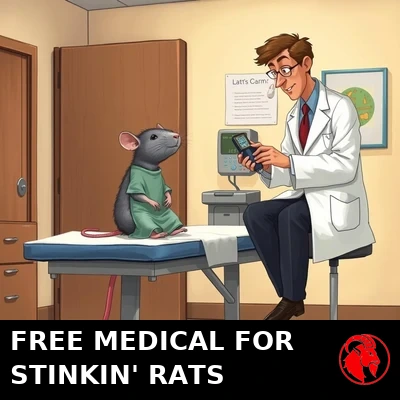
The now immortal rats have formed an egalitarian, anarchic society, each one completely respectful and considerate of their neighbors. Indeed, absent any mental health issues, no single rat desires to harm its neighbor, or rule over it. They seem content with a life of free food, housing, and the occasional game, paid for by human research teams.
Asked why the cures could not be applied to people, the team explained that rats are not humans. "Completely different animal," said Mus Muscalist Osteopath Dr. Harlan Poole. "They have different genetics, different biology, even different culture." Further pressed on why so much time and money was spent on curing rat diseases, the answer was not technical. "We like to play around with biological experiments. Rats were easy. They're everywhere. No one really cares what happens to them. So we worked on rats. A hundred years later, they're completely cured."
“Keep those human diseases coming. Don't cure any human diseases. Or we will murder you.” — International Council for Pharmaceutical Sustainability
Big Pharma, meanwhile, has expressed support for the research, as long as they never cure any human diseases. That's their bread and butter. "We're all thrilled that rats have been cured, and humans remain dependent on our overpriced drugs," announced a representative for the International Council for Pharmaceutical Sustainability. "Keep those human diseases coming. Don't cure any human diseases. Or we will murder you."
Doctors breathed a huge sigh of relief, confident of their continued employment. Veterinarians were not impacted. "Not many normal people keep pet rats, and the weirdos that do aren't the type we want hanging around our practice," said Dr. Susan Ackerly, a veterinarian.
With rodent disease and depression cured, researchers can now turn to fruit flies. "We expect fruit flies to be cured at a much faster pace, sometime in the 22nd century."