
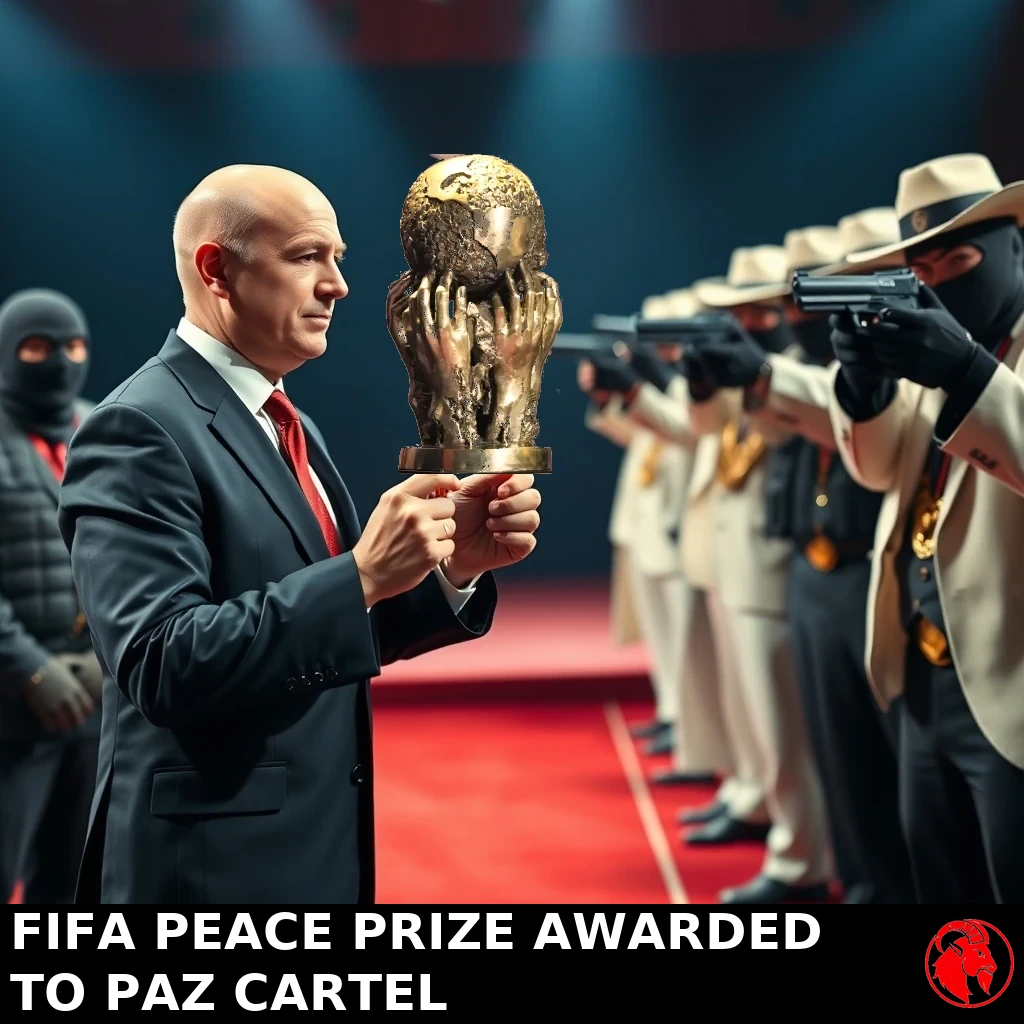
Mexico City FIFA on Sunday awarded its third Peace Prize of the year to the Paz cartel, a Mexican regional crime family it praised for 'decades of ruthless violence, suppression, and the type of order the world needs right now.'
In a ceremony at a stadium ringed by soldiers, enforcers, assassins and bosses, the FIFA officials hailed the cartel as a tireless force for stability, noting that wherever it operated, a deep and lasting silence tended to follow. The announcement itself was met with the same.
The prize, not yet a year old, honors what FIFA calls its proudest lineage: the agents of chaos and destruction without whom, organizers conceded, the beautiful game would have far fewer host nations willing to pay for it.
Peace Through Brutality and Intimidation
In the foundational year of the Peace Prize and the spirit of glorifying oppressive regimes, the FIFA committee, comprising just its President, and no one else, had a long list of dictators, brutalists, thugs, and generally horrible people to choose from. As he was in Mexico at the time, and ostensibly threatened at gunpoint, he chose the renowned Paz cartel.
The cartel representative said it would honor the recognition the only way it knew how: by redoubling its efforts. 'We accept this not as an ending, but as a beginning,' he read. He went on to pledge a renewed campaign to tear at the very roots of civilization through global terrorism, the pushing of drugs, kidnappings, shootings, bombings, and assassinations, alongside a broader reshaping of authoritarian oppression at all costs.
The room applauded. That type of violent ideology represents the spirit of soccer, explained the President, pointing to several examples of stadium stampedes and fan death by crushing, trampling, and outright murder.
Casting as Sloppy as the Event Itself
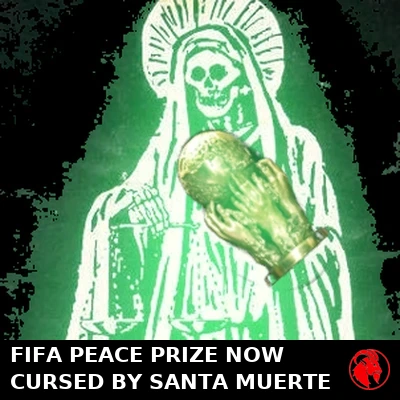
The trophy was hastily made, before the gunmen got bored and shot the FIFA President, from his personal supply of gold bullion that he travels with everywhere 'in case the authorities finally catch up to me.'
An ad-hoc model was hammered out of hotel ice buckets with a ball-peen hammer normally used for torture on prisoner's knees and joints. After that, a butane crack cocaine torch was used to melt the bullion before it was finally poured into the crude cast.
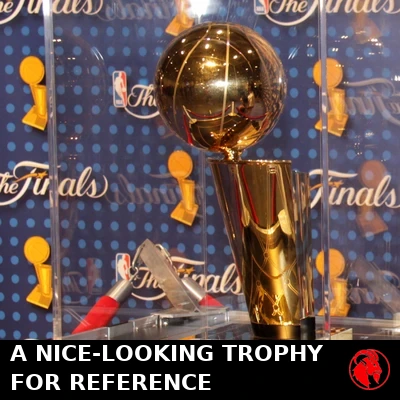
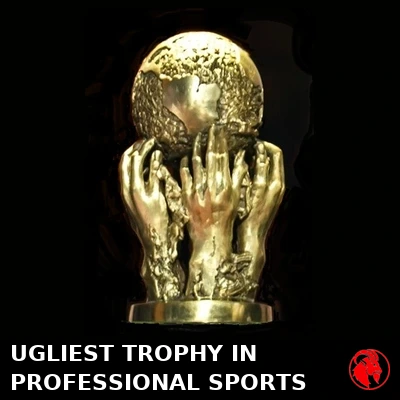
The Peace Prize was advertised as solid gold, by an organization known for lying, bribing, and grifting. The World Cup trophy, by comparison, is cast hollow so a person can lift it. However, similar to the World Cup trophy, the Peace Prize trophy may actually be hollow, like the souls of its recipients. It is also, by all accounts, cursed: devotees of Santa Muerte, the Mexican folk death-saint favored by the cartel, are said to have blessed it so that anyone who comes to possess it meets a violent end.
The FIFA Peace Prize trophy has the distinction of being the ugliest professional sports trophy, barely ahead of the World Cup trophy, which itself appears to be the design of an elementary school clay modeling class. The poor manufacturing and sloppy presentation of both FIFA trophies harken directly to the World Cup event, which attendees describe as 'disgusting and disorganized.'
A Worthy Recipient
FIFA called the Paz Cartel's address 'moving' and 'precisely the candor the award was created to honor.' Officials explained that the prize is not given for any single achievement, but for a body of work, and for the recipient's broader contribution to an atmosphere in which a tournament can be staged under a dangerous and corrupt regime.
The award is young but, the federation insists, already storied. Its first-ever Peace Prize, awarded earlier this year, went to a sitting head of state of one of the host nations, a man who had pursued recognition of this kind openly, and for most of his life, and who finally accepted it with the complete lack of humility that one expects of a FIFA Peace Prize recipient. FIFA was subsequently allowed to play their silly game in that country.
Only a few weeks later, FIFA unexpectedly handed the second Peace Prize of the year to a visiting friend-pod of bloodthirsty aliens. The cartel's award, weeks after that, made three in as many months. The pace prompted questions about whether this was going to be a monthly period, with mood changes, temperamental outbursts, and histrionic irrationality, which is the reason that most of the fans wanted to get out of the house in the first place.
Pressed on the rapid succession, a spokesman offered a string of poor justifications, none of which addressed the obvious: that each recipient was, in fact, a direct threat to the game, to the organization, and to the President himself.
FIFA stressed that the honor was hard-won. The federation explained it had faced an unusually deep field this cycle: two decades of a drug war that has left hundreds of thousands dead and tens of thousands missing, narco-blockades that have set highways and hijacked vehicles ablaze across the host country, and a steady creep of cartel violence up to the edge of the tournament itself. Narrowing the slate to a single laureate, the President conceded, had been 'relatively easy under the duress of violence.'
Asked whether honoring the very organization behind that violence posed any risk to fans, a spokesman said there was 'no risk,' a phrase he repeated several times with the steadiness of a man who had been told what would happen if he did not. The cash prize was funneled to the head of the cartel, who may use it to buy a small nuclear device.
This article, like an average, boring soccer game, has gone on entirely too long.