
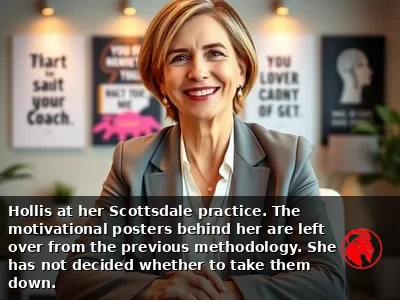
SCOTTSDALE, AZ — After fourteen years helping clients set ambitious goals, build accountability systems, and visualize their best selves, certified life coach Brenda Hollis has updated her methodology. She now recommends giving up.
"I've done a lot of reflection on this," says Hollis, 47, who holds certifications from the International Coaching Federation, the American Board of Neuro-Linguistic Programming, and a weekend intensive she completed in 2019 called Unlocking the Infinite You. "And I think the most honest thing I can tell people right now is: stop."
The pivot, which Hollis announced in a newsletter to her 2,300 subscribers last Tuesday, has been described by clients as "unexpected," "refreshing," and, in one case, "the first thing she's said that made sense."
The Framework
Hollis stresses that her new approach is not simply giving up. It is, she explains, intentional disengagement, a structured methodology she has branded the S.T.O.P. framework, which stands for Surrender, Trust, Observe, and then Please ... more surrendering.
"There's a whole process," she says. "You don't just give up. You give up deliberately. You give up with awareness. You sit with the giving up and you ask: what is this giving up telling me? And the answer, usually, is that the goal was bad."
She has developed a six-week program, a workbook, and a 90-minute masterclass, all of which guide participants through the process of identifying which areas of their lives to abandon first.
"We start with the gym," she says. "That's where most people are carrying the heaviest shame. We clear that in week one. By week three, most clients have also let go of the novel, the side hustle, and any lingering belief that they will eventually call their mother back."
A Change of Direction
Hollis says the shift began three years ago, when she noticed a pattern among her clients.
"They were doing everything right," she says. "Vision boards. Morning routines. Gratitude journals. Affirmations. Accountability partners. And they were exhausted and miserable and not getting anywhere." She pauses. "I started to wonder if I was the problem. Then I realized it was their goals that were the problem, not me. Which was a relief."
She began quietly testing the new approach with select clients, asking them to simply stop pursuing one goal per month and observe what happened.
"Nothing happened," she says. "And I felt fantastic about that. They're still trying to determine how they feel. We'll give them time."
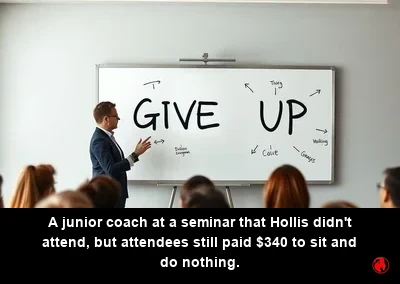
Trust
Observe
Please surrender again
The Science
Hollis is careful to note that her framework is evidence-based, citing what she describes as "a growing body of research" suggesting that many goals are not achieved by the people who set them.
"The data is very clear," she says. "Most people who want to run a marathon do not run a marathon. Most people who want to write a book do not write a book. Most people who want to learn Italian are still not speaking Italian five years later." She spreads her hands. "Clearly, we are not capable of really getting anything done."
When asked which specific studies she was referencing, Hollis said she would send them over. They had not arrived by the time of publication. It's very likely they never will.
Client Responses
Reactions among Hollis's existing clients have been mixed.
Derek Ashworth, 39, a project manager from Phoenix who had been working with Hollis for two years on a goal of launching a sustainable activewear brand, says the new direction came as a surprise.
"She told me to let it go," he says. "I asked if she meant emotionally process it and move forward with renewed clarity. She said no, she meant stop doing it." He is quiet for a moment. "I did. I feel okay."
Another client, who asked not to be named, said she had initially been upset by the advice but had come around.
"She told me my goal of becoming a yoga instructor was 'aspirationally decorative,'" the client said. "I didn't know what that meant. I looked it up. There's no definition. But I think she was right."
Response from the Coaching Community
The International Coaching Federation declined to comment on Hollis's new methodology, saying only that it "encourages all coaches to operate within established ethical guidelines."
Marcus Trent, a life coach based in Denver who has coached coaches for eleven years, said he found the approach "concerning. Particularly for the profession of coaching."
"The entire premise of coaching is that people can change and grow and achieve their goals with the right support," he said. "What Brenda is describing is the opposite of that."
He added that he had been working on a rebuttal and would share it when it was finished. He has been working on it for three weeks.
Next Steps
Hollis is currently writing a book about the methodology, titled Good Enough: A Radical Guide to Stopping. She expects to finish it by the end of the year, though she acknowledges the irony.
"My editor pointed that out," she says. "I told her that was a very normal thing to point out, and I understood why she did, and I encouraged her to stop thinking about it."
She has a waitlist of 60 new clients seeking coaching under the new framework.
"They're very motivated," she says. "I'll fix that."
Hollis offers a free 20-minute discovery call for prospective clients. The call, she notes, is entirely optional.